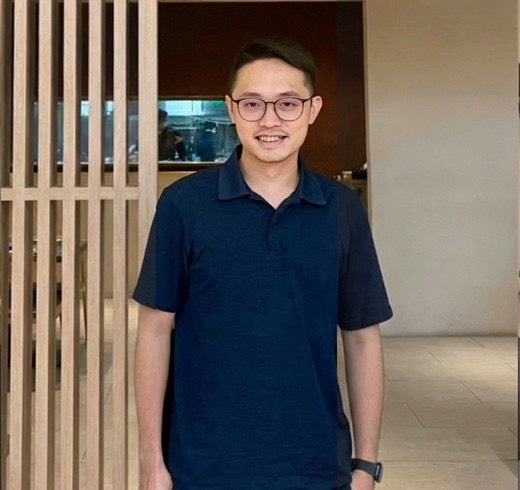
ASSISTANT PROFESSOR · FU JEN CATHOLIC UNIVERSITY
廖振成

Chen-Cheng Liao

COMPUTATIONAL CHEMISTRY & MATERIALS MODELING

Department of Chemistry, Fu Jen Catholic University
DFT / First-Principles Electrocatalysis HER / CO₂RR High-Entropy Alloys Microkinetics Machine Learning
01

Research Interests

Our lab focuses on computational chemistry and materials simulation, combining theoretical calculations, materials design, and data analysis to investigate the properties and reaction mechanisms of energy materials, catalytic systems, and novel functional materials. Through atomistic simulations, we seek to understand how materials behave at the atomic and molecular scale—and to guide the rational design of more efficient functional materials.

01 ·

High-Entropy Materials & Alloy Design

High-Entropy Materials & Alloy Design

High-entropy materials composed of multiple principal elements exhibit complex yet tunable structures and properties. We use computational simulations to study atomic arrangements, surface structures, and reaction behavior in HEAs, elucidating how elemental combinations affect stability and catalytic performance.

02 ·

Energy Catalysis & Electrochemical Mechanisms

Energy Catalysis & Electrochemical Mechanisms

We focus on key reactions in sustainable energy conversion, investigating catalyst surface roles and identifying active sites that enhance efficiency:

  • HER — Hydrogen Evolution Reaction
  • OER — Oxygen Evolution Reaction
  • CO₂RR — CO₂ Reduction Reaction
  • UOR — Urea Oxidation Reaction
03 ·

Nanomaterials & Surface Reactivity

Nanomaterials & Surface Reactivity

We study nanoparticles, bimetallic nanoclusters, and core–shell structures to probe catalytic selectivity and activity, seeking to understand how surface geometry alters reaction pathways and product distributions.

04 ·

First-Principles Calculation & Simulation

First-Principles Calculation & Simulation

Using density functional theory (DFT) at the electronic-structure level to address: why a material is more stable, why a specific site is more reactive, and how elemental doping reshapes the electronic structure.

05 ·

Machine Learning for Materials Discovery

Machine Learning for Materials Discovery

Integrating machine learning with chemistry and materials science to accelerate screening and property prediction, identifying promising candidates from vast compositional spaces.
02

Publications

01
The roles of various Fe–Cu bimetallic nanoclusters in controlling the C2 selectivity for the CO reduction reaction – a DFT study
Chen-Cheng Liao, Meng-Chi Hsieh, Yung-Yi Huang, Cheng-Yu Tu, Chun-Chih Chang*
Phys. Chem. Chem. Phys.
02
Simultaneously Boosting Direct and Indirect Urea Oxidation of Nickel Hydroxide via Strategic Yttrium Doping
Tzu-Ho Wu*, Bo-Wei Hou, Yi-Ying Lee, Meng-Che Tsai, Chen-Cheng Liao, Chun-Chih Chang
ACS Applied Materials & Interfaces
03
Modulating the Catalytic Selectivity for Urea Production in CO₂ and N₂ Reduction Reaction through Cu₁₉@Ru₆₀ Core/Shell Nanoparticle: A DFT Study
Chen-Cheng Liao, Yung-Yi Huang, Chun-Chih Chang*
J. Phys. Chem. C
04
A Computational Perspective on Carbon-Carbon Bond Formation by Single Cu Atom on Pd(111) Surface for CO Electrochemical Reduction
Chen-Cheng Liao, Tsung-Han Tsai, Chun-Chih Chang*, Ming-Kang Tsai*
Inorganics
05
The Use of Plate-type Electric Force Field for the Explicit Simulations of Electrochemical CO Dimerization on Cu(111) Surface
Chen-Cheng Liao, Tsung-Han Tsai, Chun-Chih Chang*, Ming-Kang Tsai*
Chemical Physics
2023
06
Predicting the emission wavelength of organic molecules using a combinatorial QSAR and machine learning approach
Zong-Rong Ye, …, Chen-Cheng Liao, …, Ming-Kang Tsai*
RSC Advances
2020
07
Superior Stability and Emission Quantum Yield (23% ± 3%) of Single-Layer 2D Tin Perovskite TEA₂SnI₄ via Thiocyanate Passivation
Jin-Tai Lin, …, Chen-Cheng Liao, …, Pi-Tai Chou*
Small
2020
08
Harnessing Dielectric Confinement on Tin Perovskites to Achieve Emission Quantum Yield up to 21%
Jin-Tai Lin, Chen-Cheng Liao, …, Pi-Tai Chou*, Ching-Wen Chiu*
J. Am. Chem. Soc.
2019
09
Highly Efficient N-Co-C Electrocatalyst on Reduced Graphene Oxide Derived from Vitamin-B12 for Hydrogen Evolution Reaction
Sabhapathy Palani, Chen-Cheng Liao, …, Li-Chyong Chen*
J. Materials Chemistry A
2019
10
Ethane Oxidative Dehydrogenation Mechanism on MoO₃(010) Surface: A First-Principle Study Using On-site Coulomb Correction
Chen-Cheng Liao, Chun-Chih Chang, YongMan Choi*, Ming-Kang Tsai*
Surface Science
2018
03

Experience

2026.02 — PRESENT
Assistant Professor
Department of Chemistry, Fu Jen Catholic University(輔仁大學化學系)
2024.08 — 2026.01
Assistant Professor
Dept. of Chemical and Materials Engineering, Chinese Culture University(中國文化大學)
2023.12 — 2024.07
Postdoctoral Researcher
Dept. of Chemical and Materials Engineering, Chinese Culture University
CO₂ reduction selectivity on Fe–Cu clusters/CNT; C–N coupling for urea electrosynthesis using Cu–Ru core–shell nanoparticles.
04

Education

Ph.D.
National Taiwan Normal University
Department of Chemistry
2019.02 – 2023.11
M.Sc.
National Taiwan Normal University
Department of Chemistry
2015.09 – 2019.01
B.Sc.
National Taiwan Normal University
Department of Chemistry
2011.09 – 2015.06
05

Teaching

2026 SPRING (FEB – JUN)

  • Physical Chemistry I (Quantum)
  • Advanced Physical Chemistry (Computational Chemistry)

2025 SPRING (FEB – JUN)

  • Physical Chemistry (EMI)
  • Organic Chemistry
  • Polymer Physics and Chemistry
  • Introduction to Renewable Energy
  • Development and Application for Solar Cells

2025 FALL (SEP – DEC)

  • Organic Chemistry
  • Instrumental Analysis (A & B)
  • Intro to Chemical and Materials Engineering
  • Introduction to Renewable Energy

2024 FALL (SEP – DEC)

  • Physical Chemistry (EMI)
  • Organic Chemistry
  • Intro to Chemical and Materials Engineering
  • Understanding Green Energy
  • Introduction to Energy Sources

INSTITUTIONS

  • Fu Jen Catholic University(2026.02 –)
  • Chinese Culture University(2024.08 – 2026.01)
06

Contact

Open to collaborations in computational electrochemistry, DFT-based catalyst design, and theory–experiment joint projects.

EMAIL
DEPT
Department of Chemistry
Fu Jen Catholic University, Taiwan